

Choosing Injection Mold Steel: P20, 718H, NAK80, S136 or H13?
Mold steel determines tool life, part surface quality and total cost. We compare the most common grades – P20, 718H, NAK80, S136 and H13 (2344) – and explain how to choose by production volume, resin and surface requirements.
One of the most common questions we get when quoting a mold is why prices for the same part can differ so much. A key reason is the steel used for the cavity and core. Over-specifying wastes capital; under-specifying leads to wear, rust, poor surface finish and constant tool repairs.
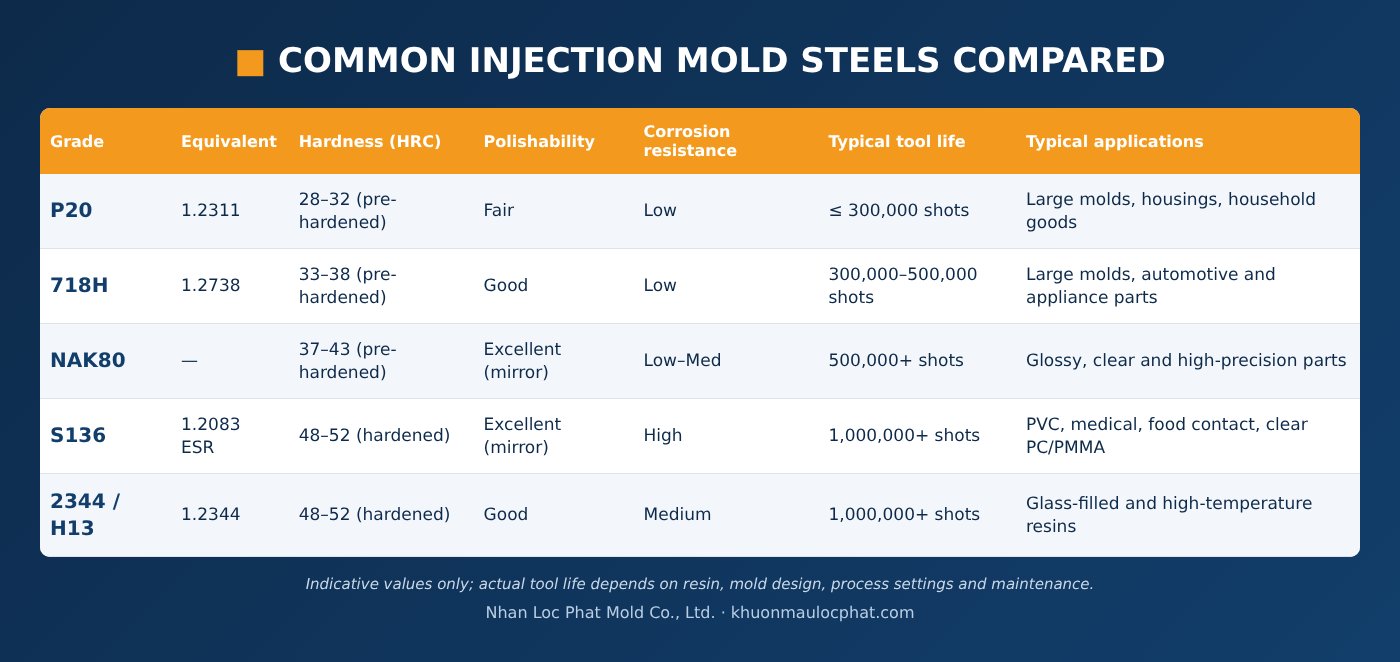
Common injection mold steels compared (indicative values)
1. Four factors that drive steel selection
- Production volume: total shots over the product life is the single most important factor.
- Resin: PVC and POM can release corrosive gases and call for stainless steel; glass-filled resins (PA+GF, PBT+GF, PP+GF) are abrasive and need harder steel.
- Surface finish: clear or mirror-finish parts (PC, PMMA) need clean, highly polishable steel; textured surfaces need steel that etches evenly.
- Mold size and budget: large molds need uniform through-hardness; budget balances upfront cost against maintenance later.
2. Common grades at a glance
P20 (1.2311) – pre-hardened to about 28–32 HRC, easy to machine and economical. Good for medium-volume molds such as household goods and housings.
718H (1.2738) – an improved P20 at about 33–38 HRC with more uniform hardness in thick sections; widely used for large automotive and appliance molds.
NAK80 – age-hardened, pre-hardened to about 37–43 HRC, very clean, excellent mirror polish and stable during machining and EDM. Ideal for glossy, clear and precision parts.
S136 (1.2083 ESR) – stainless, about 48–52 HRC after heat treatment (a pre-hardened S136H version is also available). Excellent corrosion resistance and polish; the first choice for PVC, medical, food-contact and optical parts and for high-volume tools.
H13 / 2344 (1.2344) – hot-work steel, about 48–52 HRC after heat treatment, with good heat and wear resistance for high-temperature engineering and glass-filled resins.
3. Selection guide by volume
- Under 10,000 parts (prototype / bridge tooling): P20 or carbon steel for simple parts.
- 10,000 – 300,000 parts: P20 or 718H.
- 300,000 – 1,000,000 parts: 718H or NAK80 depending on finish.
- Over 1,000,000 parts: hardened S136 or H13, with replaceable inserts at gates and high-wear areas.

Multi-cavity, high-volume molds usually need harder, longer-lasting steel
4. Not every plate needs premium steel
Only molding components (cavity, core, inserts, slides, lifters) need premium mold steel. Mold base plates are typically S50C/S55C. For high-volume tools, hardened inserts at gates and wear areas can be replaced without reworking the whole cavity.
5. Common mistakes
- Using low-cost steel for high-volume parts – faster wear, more flash, higher total cost.
- Using non-stainless steel for PVC or humid storage – rust and pitting on the cavity.
- Specifying mirror polish on unsuitable steel.
- Not checking material origin – request mill certificates for export or high-value tools.
There is no single "best" mold steel – only the right steel for your volume, resin and finish. Share your expected volume and resin when requesting a quote so we can propose the lowest total cost per part.
Nhan Loc Phat Mold Co., Ltd. (Ho Chi Minh City, Vietnam) provides material consulting, injection mold design and manufacturing under strict design confidentiality. Contact us for a free consultation.
