
Turnkey Plastic Injection Mold Making: From Concept to Mass Production
Turning a product idea into thousands of consistent plastic parts takes product design, mold design, machining, T0/T1 trials and production molding. Here is how our turnkey process works and what customers should watch at each stage.
Many customers come to us with only an idea, a sketch or an old sample. Getting from there to mass-produced plastic parts involves several tightly linked stages. Working with one supplier for design, tooling and molding gives you a single point of responsibility and removes the finger-pointing between designer, toolmaker and molder.
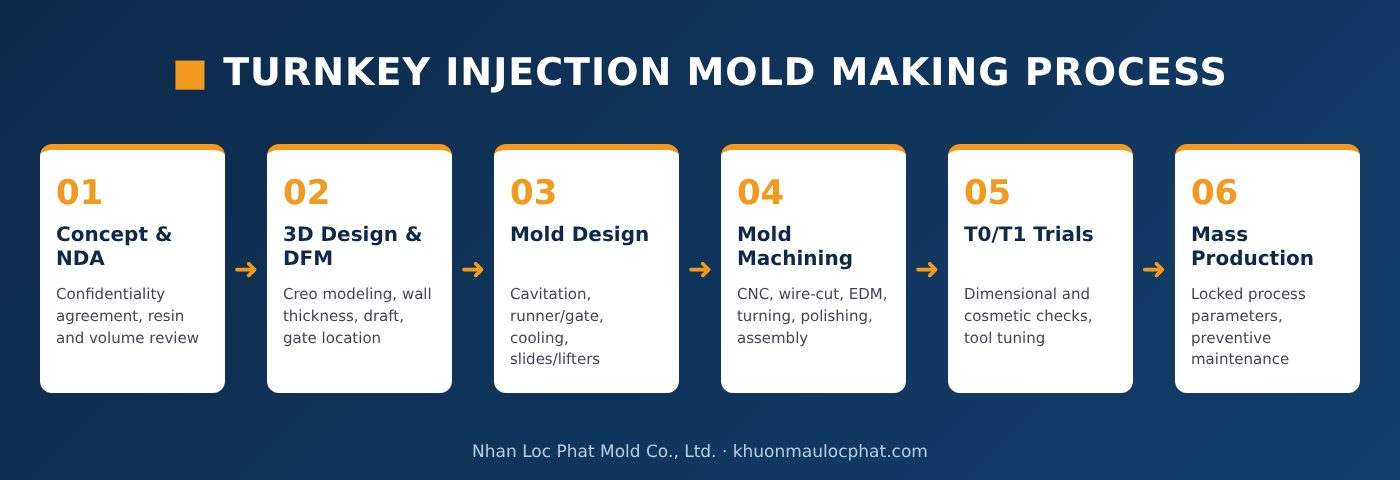
Our 6-step turnkey injection mold making process
1. Concept review and NDA
For unreleased products, the design is your most valuable asset. We sign a non-disclosure agreement before detailed discussions, and project files are accessible only to the engineers working on them. At this stage we clarify function, operating environment, resin (PP, ABS, PC, PA, POM…), annual volume and tooling budget.
2. 3D product design and DFM
Our engineers build the 3D model (Creo, AutoCAD) and run a Design for Manufacturing review: wall thickness, draft angles, ribs, bosses, undercuts, parting line and gate location. Changes at this stage cost almost nothing; changes after the mold is cut cost time and money. Prototypes (3D printed or CNC machined) can be made for fit and appearance checks.
3. Mold design
- Cavitation: 1, 2, 4, 8 cavities depending on volume and part size.
- Feed system: cold or hot runner; gate type (direct, sub/tunnel, edge, pin point…).
- Cooling: water lines in cavity and core to shorten cycle time and reduce warpage.
- Ejection and actions: ejector pins and plates, slides and lifters for undercuts.
- Steel selection: P20, 718H, NAK80, S136, H13 (2344)… matched to volume and resin.
4. Machining and assembly
Mold components are produced in-house on CNC milling, wire-cut, EDM and lathe equipment, then polished, textured if required, and assembled. Keeping machining in-house helps control lead time and keeps your design data inside our facility.
5. T0/T1 trials and tuning
The mold is sampled on our injection machines. T0/T1 parts are checked for dimensions, cosmetic defects (flash, sink marks, weld lines, warpage, short shots) and assembly. The tool is adjusted and re-sampled (T2, T3…) until the parts meet specification and are approved by the customer.
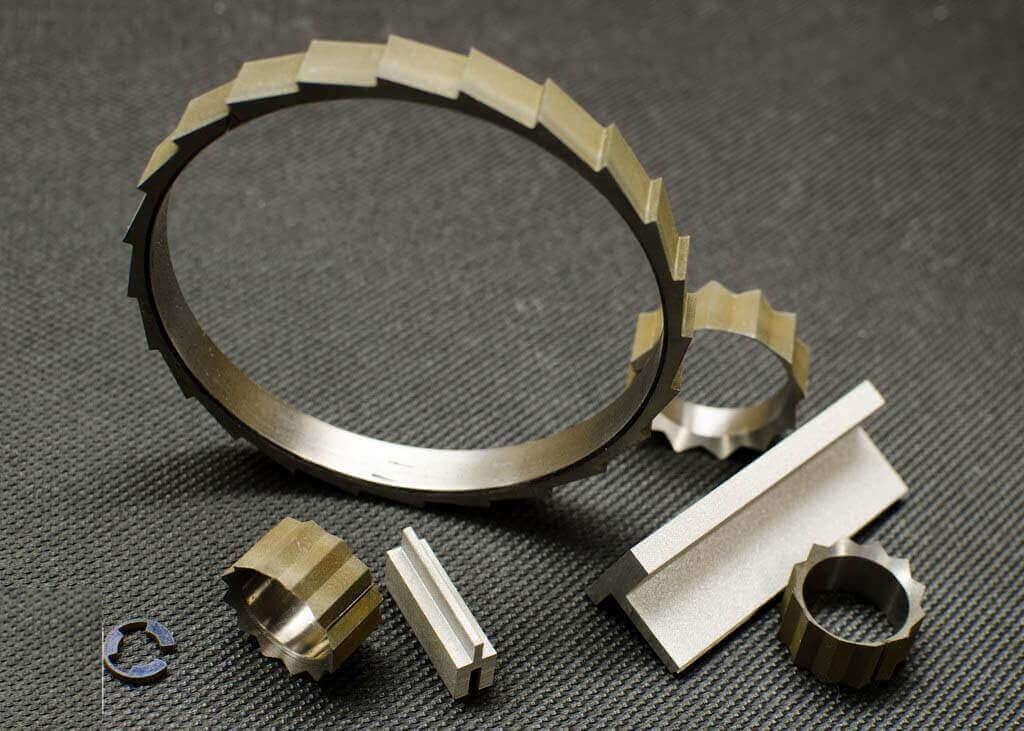
Precision parts made by wire-cut EDM
6. Production molding and maintenance
Approved molds go into production with locked process parameters. Preventive maintenance keeps quality stable and extends tool life. Because we built the mold, production issues are diagnosed and fixed quickly.
Tips for buyers
- Share annual volume and resin early – they drive mold configuration and price.
- Compare total cost per part (cavities, steel, cycle time, piece price), not just tooling price.
- Agree on approval criteria (dimensions, cosmetics) up front to avoid long sampling loops.
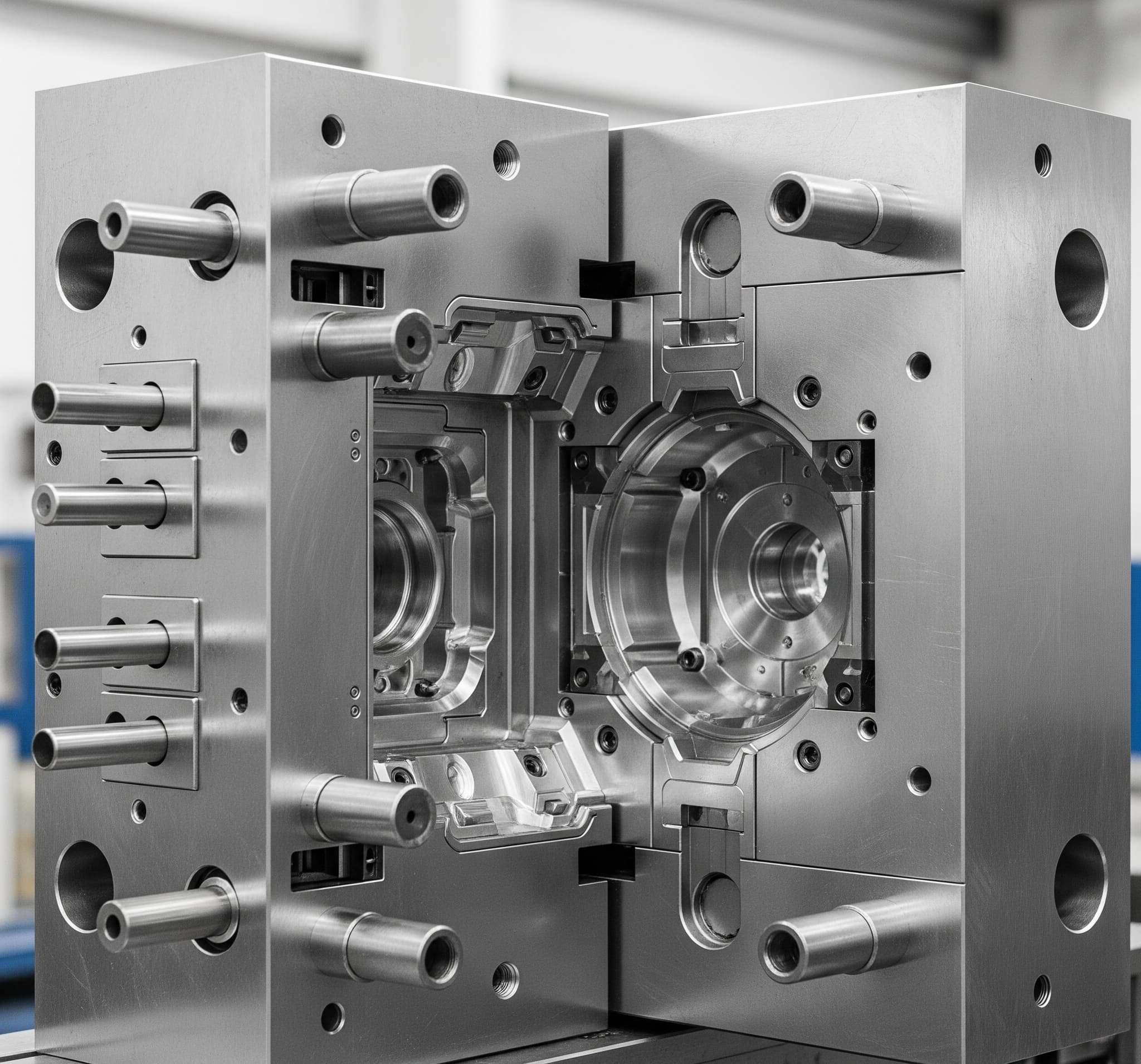
Injection mold: cavity and core halves after machining
Nhan Loc Phat Mold Co., Ltd. (Ho Chi Minh City, Vietnam) offers product design, injection mold design and manufacturing, and contract molding under strict design confidentiality. Contact us to discuss your project.
