
Single-Cavity or 4-Cavity Mold: How to Choose
A multi-cavity mold lowers the piece price but needs much more upfront investment. This article compares single-cavity and 4-cavity molds, shows how to calculate the break-even point and suggests middle-ground options.
When ordering an injection mold, the first question most customers face is: should the mold be single-cavity or multi-cavity (2, 4, 8…)? A multi-cavity mold lowers the piece price but needs a much larger upfront investment. Choose wrong and you either tie up cash in a large mold that never runs at capacity, or lose your price advantage when orders grow. This article compares both options and shows how to calculate the break-even point yourself.
Single-cavity mold: low investment, flexible
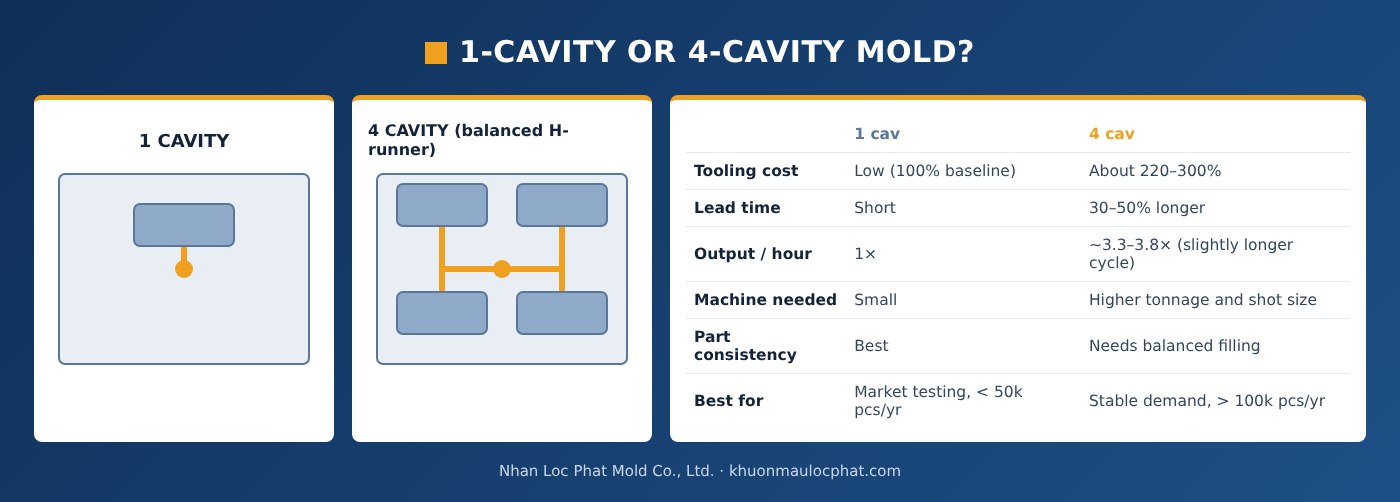
Each cycle produces one part. Advantages:
- Lower tooling cost and shorter lead time, good when speed to market matters.
- Best consistency: no cavity-to-cavity variation, easier to hold tight tolerances and to tune the mold at T0 and T1.
- Runs on a small press with a low machine rate.
- Low risk while the part design may still change.
The downside is a higher piece price because each part uses more machine time, and limited capacity when demand grows quickly.
4-cavity mold: lower piece price, needs enough volume
Each cycle produces four parts. The cycle is usually only slightly longer than a single-cavity mold, so hourly output rises by about 3.3–3.8 times. In exchange:
- Tooling usually costs about 2.2–3 times a single-cavity mold, with a longer lead time.
- It needs a press with higher tonnage and shot size, so a higher machine rate.
- The runner must be naturally balanced (H-pattern or radial) so all four cavities fill at the same time. An unbalanced layout gives short shots in one cavity and flash in another.
- If one cavity is damaged it is usually blocked off to keep running, which cuts output by 25%.
Break-even: when does a 4-cavity mold pay off?
A simple method: divide the extra tooling cost by the saving per part.
Break-even quantity = (4-cav mold cost − 1-cav mold cost) ÷ (machine cost per part, 1-cav − machine cost per part, 4-cav)
Illustrative example:
- Single-cavity mold: 80 million VND, 30 s cycle, 120 parts/hour.
- 4-cavity mold: 200 million VND, 36 s cycle, 400 parts/hour.
- Machine rate 250,000 VND/hour, giving about 2,083 VND/part for the single-cavity mold and 625 VND/part for the 4-cavity mold.
- Break-even: 120,000,000 ÷ (2,083 − 625) ≈ 82,000 parts.
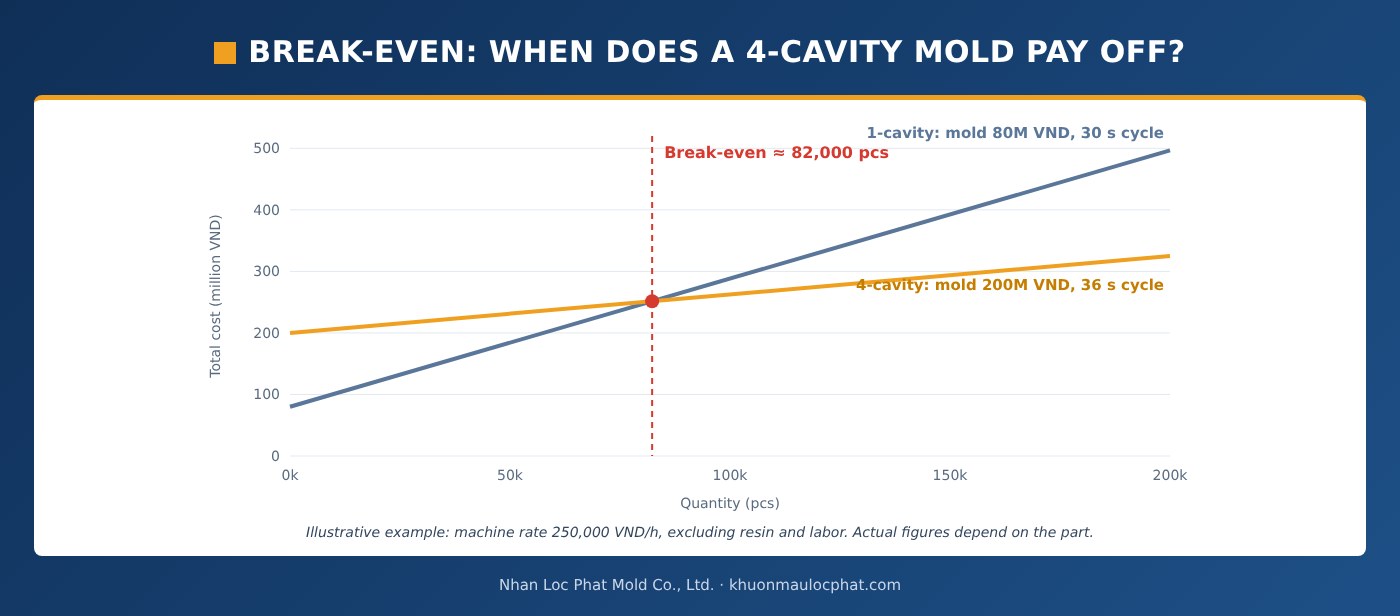
So if total lifetime volume is below roughly 82,000 parts, the single-cavity mold is cheaper. Above that, the 4-cavity mold starts paying back, and the more you run, the more you save. This is only an example: if the 4-cavity mold must run on a larger press with a higher hourly rate, the break-even point moves to a higher volume.
5 questions to answer before choosing the cavity count
- What is the real annual volume and product life? Use confirmed orders, not hopes.
- Is the part design frozen? Changing a 4-cavity mold costs several times more than changing a single-cavity mold.
- How tight are the tolerances? Precision assembly parts and medical parts often favor fewer cavities or require per-cavity control.
- Is a suitable press available? A 4-cavity mold needs enough tonnage, shot size and tie-bar spacing.
- How much can your cash flow invest? A large mold takes capital upfront, while sales revenue comes in months later.
Middle-ground options worth considering
- 2-cavity mold: a balance between investment and piece price for medium volumes.
- Build a 4-cavity mold base but cut only 2 cavities first: when demand grows, just add cavities instead of building a new mold.
- Start with a single-cavity mold to test the market, then invest in a multi-cavity mold once volume is stable. Keep the single-cavity mold as a backup.
- Family mold: mold several different parts of the same product in one tool, efficient when parts share the same resin and similar size.
Nhan Loc Phat recommends the right cavity count for each project
Nhan Loc Phat Mold Co., Ltd. offers a full service from product design, mold design and toolmaking to production molding on our own presses. Because we both build the molds and run them, we calculate the real total cost (tooling, machine time, resin, labor) and recommend the cavity count that best fits your volume and budget. All designs are kept confidential until your product is officially launched. Send us your drawings or product idea for advice and a quotation.